Monday, September 17
A driving tour today. We headed down some of the shoreline roads to the south and east and to the community of Blandford. There is another monument to the persons killed in the Swissair Flight 111 tragedy. The unidentifiable remains of some of the victims are interred here. A very somber site.
 |
| A mass grave lies within the chained off area. |
 |
| The list of names of the people killed are etched in the stone. Memorials lie in front. |
We continued our drive and made our way along the shoreline to Mahone Bay and Blue Rocks. Both places very picturesque.
 |
| The shoreline of Bayswater Provincial Park on Hwy 329 near the Swissair Memorial. |
 |
| The dunes around Bayswater Beach |
 |
| Bayswater beach. Powdery white sand. No one here this day. |
 |
| The view of Chester Basin |
 |
| We stopped for lunch here at the Seaside Shanty in Chester Basin on Hwy 3. We had a grilled Haddock burger. Very tasty! |
 |
| Shops along the road at Mahone Bay |
 |
| Mahone Bay is known, among other things, as home to the 'three churches'. There are actually more in town, but three are prominent and all in a row along the waterfront. All had beautiful stained glass windows and are kept in immaculate condition. |
 |
| St James Anglican Church - built 1887 |
 |
| St John's Evangelical Lutheran Church - built 1869 |
 |
| Trinity United Church - built 1861 |
 |
| Pretty little town of Mahone Bay. |
The next stop was the famous fishing village of Lunenburg, home of Bluenose 2. Of course she wasn't in port today, she was in Halifax giving rides to paying tourists. That's OK, we saw her yesterday.
 |
| We continued down Hwy 3 toward Lunenburg. These are a few of the businesses at the entrance to the town. |
 |
| Before we got too far we diverted down a side road to the beautiful village of Blue Rocks just few miles out of Lunenburg. The slate grey rocks take on a blue tinge under certain light......some say. |
 |
| Lots of wear on these rocks. |
 |
| Just a lovely spot. |
 |
| Doesn't get a lot of visitors! |
 |
| Lovely Lunenburg homes. |
 |
| Stately streets |
 |
| Waterfront businesses. So colourful! |
 |
| Fishing boat getting prepped for an outing. |
 |
| From the warf toward the business area. |
 |
| Lots of restaurants |
 |
| Fisherman's Memorial |
 |
| What a beautiful scene! |
 |
| You could sit and have a chat with this old salt. A one-sided conversation though. |
 |
| Beautifully restored St. John's Anglican Church in Lunenburg |
 |
| This is not the original church from 1753, but is on the same site. |
 |
| Stained glass window with a fishing theme. It's hard to see in the picture but there are boats displayed in the glasswork. |
 |
| The inside of the church with rich woodwork. |
 |
| Above the alter you can see golden 'stars' representing what fishermen see at night on the ocean. |
 |
| They had a huge pipe organ. |
 |
| Another beautiful glass window with a fishing theme. |
 |
| Some of the best views of the town are from across the bay at the golf course which is where this and the next two are taken from. |
 |
| The traffic monitor on the highway heading home! |
We saw some very lovely spots today. Well worth the trip.
Tuesday, September 18
We headed back into Halifax again today. I know the route well by now! Today we were at the historic fort 'The Citadel'.
Here's some history behind the Citadel:
The Citadel's Role in Halifax's History
It’s not an exaggeration to say Halifax, a city on the sea, owes its existence to the Citadel. It was the large hill overlooking the easily defended harbour below that led the British military to found the town there in 1749. Among the first buildings constructed was a wooden guardhouse on top of what would eventually be called Citadel Hill, with Halifax’s first settlers building their homes at the base of the hill, closer to the water. Over the years, as the fort grew, so too did the town, with much of Halifax dedicated to supplying the soldiers with both essential supplies and off-duty entertainment.
Citadel Hill Today
Today, the Halifax Citadel continues to watch over the city’s downtown core, although now its role is as a reminder of Halifax’s past and not as a military fortification. The present Citadel, completed in 1856, is officially called Fort George, named after Britain’s King George II, and is actually the fourth in a series of forts to sit atop what is now known as Citadel Hill. Its distinctive star shape is typical of many 19th century forts built by the British military and gave the garrison sweeping arcs of fire. From its deep defensive ditch, soldiers pointed muskets from every angle of its stout walls and large cannons lined its ramparts. It’s easy to see why no enemy force ever dared to attack the Halifax Citadel.
 |
| The Citadel was built by the British. The present fort was built in 1856. |
 |
| The barracks, chapel, store, and warehouse are in this building. Apparently they could remove the roof and install cannons if an attack was imminent. No one ever attacked it. |
 |
| Awaiting orders |
 |
| Prepped and ready for action. |
 |
| Test firing his musket. |
 |
| Signal tower. They could send messages by raising certain flags. |
 |
| Ready for changing of the guard. |
 |
| Defensive ditch that surrounds the fort. |
 |
| Main gate. |
 |
| Museum upstairs in the main building. Note the shape of the doors. Designed this way to add strength to the structure and narrow to make enemy infiltration harder. |
 |
| They had some interesting World War 1 & 2 displays. |
 |
| Cannon, ready to defend. |
 |
| This was a mock-up of a WW 1 trench. Very interesting. |
Next we went back to the Harbour to visit the Maritime Museum of the Atlantic. First though, tied up to the warf in front of the museum was Bluenose 2. They had 'open decks' which meant we were allowed on board to look around the top deck. What a beauty she is.
 |
| Old and new. The Bluenose II is across the warf. The yacht in front is called 'My Way' and registered in Naples, Fl. Anybody want to guess who owns it? (see the bottom of the blog) |
 |
| The Bluenose II |
 |
| If you want to learn more about the history of Bluenose and Bluenose II, click here. |
 |
| Beautiful decks. The crew keeps her shiny! |
 |
| The Captain |
 |
| They let me steer her......while it was tied up of course. |
 |
| The stories this wheel could tell! |
Finally it was time to go inside the Museum of the Atlantic. They have beautiful exhibits from artifacts to full size boats on display.
 |
| Beautiful Fresnel lens from a lighthouse. |
 |
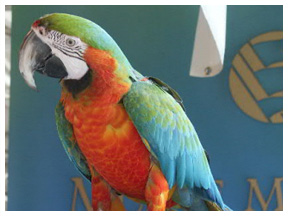
| This is 'Merlin' the museum mascot. |
 |
| Merlin has his own Webcam. You can see him live here. |
Merlin, our Rainbow Macaw, joined the Maritime Museum crew during the Pets at Sea, March Break event in 2006. Merlin is particularly fond of green grapes, peanuts, carrots, walnuts and yes, even crackers! Merlin has two meals each day. Rainbows macaws are a hybrid, caused by cross-breeding the Scarlet and Golden Blue macaw. Most people assume that Merlin comes from the Brazilian Rain Forest but the closest he'll ever get is if our sprinkler system goes off by accident!
Merlin has a visit to the vet every six months for a general inspection and to have his pin feathers clipped. This prevents him from taking off into the rafters of the Museum and allows for people to enjoy him at closer range. Since macaws can live to be 80 or 90 years old, you'll have plenty of chances to stop in for a visit.
Merlin is quite talkative and laughs and sneezes on a regular basis. "Cracker" and "Peek-a-boo" are a regular part of his vocabulary. He is usually willing to talk to people but is also quite happy to chat to himself, especially during the middle of the afternoon, when he sometimes has a nap.
 |
| They have a display of the hurricanes and tropical storms from this year. Very interesting to see them mapped out. Florence is the brown line in the middle that started in Africa. |
 |
| Here is Bluenose II setting out with a load of tourists. They were sold out for days in advance so we never got a chance to sail aboard her. |
 |
They had an extensive display of Titanic artifacts and stories. Some of the victims of the sinking are buried in Halifax.
You can read more of the story and of the museum's artifacts here. |
 |
| hanging wasn't enough for nasty pirates! |
 |
| Yikes! No pirate life for me! |
 |
| Beautiful display of wooden boats. |
 |
| The Halifax explosion of December 6, 1917. |
Approximately six minutes after 9:00 am on December 6, 1917, a dreadful mis-communication between two ships in the harbour resulted in an Explosion of cataclysmic proportions. 2,000 people were killed and 9,000 more were injured. The city was reduced to ruins and debris.
 |
| The ships blew apart sending metal shrapnel for miles. Here is one piece. |
 |
| Vince Coleman, telegraph operator sent this final message to stop the incoming passenger trains. He died in the explosion. |
 |
| Models of military ships. Very detailed. |
 |
| This is the hydrofoil Bras d'Or Lakes. She was the fastest military ship in the world in the 1960's. Based on technology by Alexander Graham Bell. |
Lots of very interesting displays in the museum. We spent several hours there.
For more information on the 'My Way' yacht look
here. At first we thought maybe Frank Sinatra owned her, or maybe even Donald Trump. It has had several owners and this is her third name.
Want to see inside? Click
here.
No, we aren't buying a yacht! Doesn't hurt to dream though, right?
....and that was Our View From Here!




I always loved the interesting colourful builldings in Lunnenburg. and along that coast. and great place for wonderful sights. Seeing the Bluenose II is always nice as well. Keep enjoying the journey.
ReplyDeleteOnce again an awesome tour! Gotta say those churches are so impressive even being so simple (except the stained glass of course)! So interesting, thanks again Dave!
ReplyDelete